
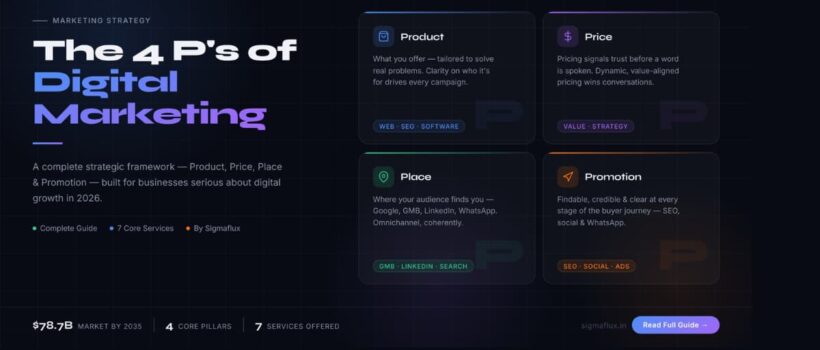

The digital marketing agency market was valued at USD 20.63 billion in 2025. By 2035, that number is projected to reach USD 78.73 billion. That kind of growth means more competition, more noise, and more businesses fighting for the same attention. In that environment, winging your marketing strategy is genuinely expensive. The businesses that grow consistently usually have one thing in common — they know exactly what they are doing and why, before they spend a single rupee on campaigns.
At Sigmaflux, we work with businesses across Web Development, SEO, Social Media Marketing, Google My Business (GMB) optimization, WhatsApp Marketing, LinkedIn Marketing, and Software Development. But before any of that delivers real results, there needs to be a strategy underneath it — and that strategy starts with the 4 P’s.
First introduced in the 1960s and still relevant in 2026, the 4 P’s — Product, Price, Place, and Promotion — give businesses a practical way to audit their marketing, fix what is broken, and build something that grows consistently.
Your product is where everything begins. It is what you are putting into the market to solve a real problem — whether that is a physical item, a digital service, a software tool, or a combination of all three.
Here is a pattern that shows up constantly with businesses that struggle to grow: they can explain their service in detail, but they cannot clearly explain who it is for or what problem it removes. Clayton Christensen tracked this across thousands of product launches — over 30,000 new products enter the market every year, and the majority quietly vanish within months. The product itself is rarely the issue. The failure usually comes down to one thing: the team understood what they built, but they never properly figured out who actually needed it. That misalignment shows up in every campaign, every message, and every pitch that does not land.
For Sigmaflux, the product is a range of services built around one goal — helping businesses grow online:
Every service Sigmaflux offers starts with one question: what problem does this client’s customer actually need solved? The answer shapes everything else.
Pricing is one of those things businesses often set once and forget. But it quietly shapes how potential clients perceive you before they have spoken to anyone on your team. A price that feels too low raises quality questions. A price with no clear explanation raises questions about trust. Getting it right means thinking about what your pricing communicates, not just what it covers.
Digital marketing pricing does not follow a fixed formula. A social media retainer for a local restaurant looks nothing like one for a national eCommerce brand. Scope changes. Platforms change. The time and skill required change. Add in fluctuating market demand and how competitive a particular service has become, and you have pricing that needs to be thought through properly for each client rather than pulled from a rate card.
Most agencies use one of four approaches:
Clutch.co data puts SEO, social media, and content work at roughly $100–$149 per hour in global markets, with monthly retainers anywhere from $5,000 for smaller campaigns to well over $50,000 for enterprise-level work. For businesses in India working with an agency like Sigmaflux, that same level of strategic execution typically comes at a fraction of that cost, which is not just a pricing advantage, it is a positioning one worth communicating clearly.
The original idea of Place was straightforward — put your product where people can physically get to it. A shop on a busy street, a product in a popular store. Digital marketing stretched that definition completely. Now, Place is wherever your audience is already spending time — a search result, a social feed, a messaging app, a business listing. If they can find you there, that counts as a place.
A potential client might stumble across your business at 11 p.m., searching Google for something specific. Or a colleague mentions your name in a WhatsApp group. Or your LinkedIn post gets shared by someone outside your immediate network and lands in front of exactly the right person. These are not moments you can fully control or predict — but you can make sure that when they happen, there is something worth landing on. That is what the place strategy is really about.
What ties all of this together is consistency. Whether someone first saw your brand on Instagram, clicked a Google ad, or found you through a WhatsApp recommendation, they should land in the same quality of experience. That continuity is what omnichannel actually means in practice. It is not about being everywhere. It is about being coherent everywhere.
For Sigmaflux clients, that means being visible and accessible across:
Geographic targeting sharpens Place further. Tools like Google Ads and Meta’s location targeting let brands reach people by city, neighbourhood, or radius — which sits at the core of how Sigmaflux approaches local SEO and GMB strategy for clients.
Promotion is usually the first thing people picture when they think about marketing — the ad that follows you around, the post that shows up twice a day, the email that lands on a Monday morning. But running a promotion well is less about volume and more about timing and relevance. Showing up at the wrong moment with the wrong message wastes budget. Showing up at the right one builds a brand.
Think about how your own customers actually behave. They search something, skim the first few results, check your social media, read a review or two, maybe send a WhatsApp enquiry — and then decide. That decision-making process — search, check social, read a review, make a call — can happen in under ten minutes. Which means if your brand is missing from even one of those steps, you may have already lost the sale before the person even knew your name. Promotion is not about being loud. It is about being findable, credible, and clear at every stage of that journey.
A few things worth understanding:
When SEO, content, social, and conversion are planned together rather than separately, each one makes the others stronger. A blog post improves search rankings. The search ranking brings traffic. The traffic feeds retargeting. The retargeting converts. Pull one piece out, and the whole system slows down. At Sigmaflux, that connected approach is how we build promotion strategies — not as isolated campaigns, but as systems where everything earns its place.
Platforms like Clutch, DesignRush, and Upwork have made agency comparison genuinely easy. A business owner can pull up reviews, pricing ranges, past clients, and service specialisations in a few clicks. Agencies like WebFX, Ignite Visibility, SmartSites, and NP Digital show up prominently on all of them — they have large client portfolios, substantial ad spend under management, and years of reviews backing their credibility. That visibility is real, and pretending otherwise would not help anyone.
Sigmaflux does not need to win every pitch. The goal is to be the obvious choice for the right client — businesses that want serious digital strategy without getting lost inside a large agency’s client list.
What actually builds client trust in this space:
What Sigmaflux can genuinely offer is responsiveness. Larger agencies carry more accounts, more layers of approval, and more internal processes. That is not a criticism — it is just how scale works. For a client who wants to move quickly, get direct answers, and not feel like account number 247 in a spreadsheet, working with a focused boutique agency makes a practical difference. That is the real competitive position — not trying to out-scale anyone, but being genuinely useful to the clients who fit.
The 4 P’s have survived sixty-plus years of marketing shifts — from TV ads to search engines to social media — because the core questions they ask never go out of date. Is what you are offering actually solving something? Does your pricing reflect what you deliver? Can your audience find you where they are already looking? Is your message connecting or just existing? These are not complicated questions. But most businesses that are struggling with growth cannot answer all four with confidence.
When a campaign underperforms, most businesses instinctively want to fix the promotion — change the creative, increase the budget, try a different platform. But the real issue is often somewhere else entirely. Sometimes the offer itself is not compelling enough. Sometimes the pricing makes people hesitate before they even enquire. Sometimes, the audience simply cannot find the business through the channels they actually use. Promotion cannot fix a weak product or a confusing price. Getting the diagnosis right first saves a lot of wasted spending.
When all four are genuinely aligned, something shifts. Marketing decisions become easier because there is a framework to check them against. Campaigns become easier to repeat because the logic behind them is solid. Growth becomes easier to sustain because it is built on clarity rather than luck.
Sigmaflux applies this thinking across every engagement — from building websites that convert, to running SEO that compounds over time, managing GMB profiles that drive local visits, and running WhatsApp and LinkedIn strategies that reach real decision-makers.
If you want to work through what this looks like for your specific business, we are ready to start that conversation.