
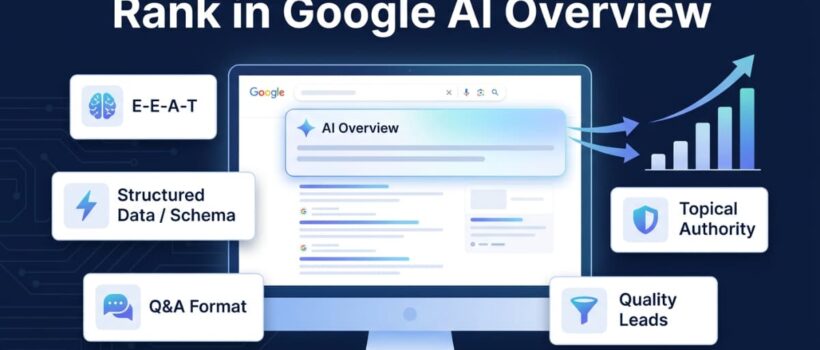

Primary Keywords — Ranking Strategy
| AI Overview ranking | Rank in Google AI Overview | AI Overview SEO strategy | SGE optimization |
| answer engine optimization (AEO) | generative search results | E-E-A-T for AI search | structured content AI |
| topical authority SEO | conversational query SEO | featured in AI Overview | how to appear in AI Overviews |
Lead Generation Keywords
| AI Overview leads | quality lead generation AI search | high-intent AI search visitors | zero-click lead generation |
| content-to-lead funnel | TOFU MOFU BOFU AI traffic | AI Overview conversion strategy | pre-qualified AI visitors |
Long-tail Keywords: “How to get featured in Google AI Overview” · “How to generate leads from AI search” · “Why is my content not in AI Overview” · “Best content format for AI Overview” · “Does schema markup help AI Overview?”
Google’s AI Overview (formerly SGE — Search Generative Experience) places an AI-generated answer at the very top of search results, synthesized from multiple trusted sources. For businesses, appearing here is the new #1 ranking. It signals to every reader: Google trusts this source. Mastering AI Overview SEO strategy is now one of the highest-leverage actions in digital marketing.
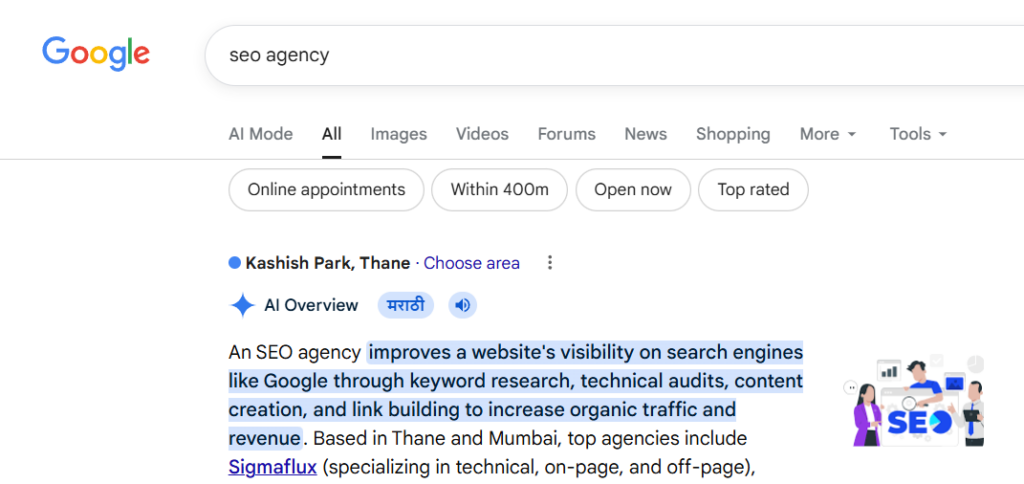
This guide covers two critical opportunities:
Google’s AI Overview pulls from sources it considers authoritative. The framework Google uses to evaluate this is E-E-A-T: Experience, Expertise, Authoritativeness, and Trustworthiness. This is the foundation of all AI Overview SEO strategy.
| Key insightThe AI Overview does not favor the most popular site — it favors the most trustworthy, clearly written answer. A well-written piece from a mid-size site can outrank a massive domain if it answers the question more clearly and credibly. |
Answer engine optimization (AEO) is the practice of writing content that directly and immediately answers questions. The single most important strategy for AI Overview visibility is putting your answer in the first 2–3 sentences — not buried three paragraphs down.
| Step 4: Add schema markup, FAQPage, HowTo, Article, and Organization schema to help Google’s AI extract and cite your answers. This is critical for structured content AI visibility. | Step 6: Earn citations. Guest posts, original data studies, and industry mentions increase your authority across generative search results. Be the source others reference. |
| Step 5: Build topical authority. A pillar page + cluster articles covering every subtopic signals deep subject-matter expertise — the core topical authority SEO signal the AI Overview rewards. | Step 4: Add schema markup, FAQPage, HowTo, Article, and Organization schema help Google’s AI extract and cite your answers. This is critical for structured content AI visibility. |
AI Overview leads are fundamentally different from cold paid-ad clicks. By the time a high-intent AI search visitor reaches your site, they have already read your answer and decided you are credible. This is the new zero-click lead generation opportunity — even if they don’t click immediately, your brand is cited as the authority.
Google’s AI Overview (formerly SGE — Search Generative Experience) places an AI-generated answer at the very top of search results, synthesized from multiple trusted sources. For businesses, appearing here is the new #1 ranking. It signals to every reader: Google trusts this source. Mastering AI Overview SEO strategy is now one of the highest-leverage actions in digital marketing.
This guide covers two critical opportunities:
Google’s AI Overview pulls from sources it considers authoritative. The framework Google uses to evaluate this is E-E-A-T: Experience, Expertise, Authoritativeness, and Trustworthiness. This is the foundation of all AI Overview SEO strategy.
| Key insightThe AI Overview does not favor the most popular site — it favors the most trustworthy, clearly written answer. A well-written piece from a mid-size site can outrank a massive domain if it answers the question more clearly and credibly. |
Answer engine optimization (AEO) is the practice of writing content that directly and immediately answers questions. The single most important strategy for AI Overview visibility is putting your answer in the first 2–3 sentences — not buried three paragraphs down.
| Step 4: Add schema markup, FAQPage, HowTo, Article, and Organization schema to help Google’s AI extract and cite your answers. This is critical for structured content AI visibility. | Step 6: Earn citations. Guest posts, original data studies, and industry mentions increase your authority across generative search results. Be the source others reference. |
| Step 5: Build topical authority. A pillar page + cluster articles covering every subtopic signals deep subject-matter expertise — the core topical authority SEO signal the AI Overview rewards. | Step 4: Add schema markup, FAQPage, HowTo, Article, and Organization schema help Google’s AI extract and cite your answers. This is critical for structured content AI visibility. |
AI Overview leads are fundamentally different from cold paid-ad clicks. By the time a high-intent AI search visitor reaches your site, they have already read your answer and decided you are credible. This is the new zero-click lead generation opportunity — even if they don’t click immediately, your brand is cited as the authority.
| TOFU — AI Overview citedBlog answers search query · Appears in generative search result |
| ↓ |
| BOFU — Sales touchpoint, Follow-up email sequence → strategy call booking |
| ↓ |
| Quality lead converted Pre-qualified · High-intent · High trust |
| ↓ |
| Quality lead convertedPre-qualified · High-intent · High trust |
Every page that appears in the AI Overview must have a clear CTA above the fold, a relevant lead magnet, and strong trust signals. These pre-qualified AI visitors are ready to act — make sure your page gives them a reason to.
You cannot convert leads you cannot measure. Set up tracking to understand exactly which pages are generating AI Overview traffic and producing quality lead generation from AI search.
If your content is good enough for Google to cite, it is good enough to become a premium asset that drives quality lead generation from AI search.
| Mistake | Fix |
| Burying answers deep in the article | Lead with a direct, citable answer in sentence 1 |
| No author bio or credentials | Strengthen E-E-A-T on every article page |
| No CTA on high-traffic AI-cited pages | Add lead magnet and CTA above the fold |
| Missing FAQPage / HowTo schema markup | Add structured content for AI with schema |
| Ignoring conversational query SEO | Target ‘How do I…’ and ‘What is…’ questions |
| Single pages, no topical cluster | Build pillar + cluster for topical authority SEO |
Ranking in Google’s AI Overview through answer engine optimization (AEO), strong E-E-A-T signals, structured content for AI search, and smart TOFU → MOFU → BOFU AI traffic funnels is the most powerful lead generation strategy available right now. The brands that appear in generative search results today will own the credibility advantage for years to come.
Every page that appears in the AI Overview must have a clear CTA above the fold, a relevant lead magnet, and strong trust signals. These pre-qualified AI visitors are ready to act — make sure your page gives them a reason to.
You cannot convert leads you cannot measure. Set up tracking to understand exactly which pages are generating AI Overview traffic and producing quality lead generation from AI search.
If your content is good enough for Google to cite, it is good enough to become a premium asset that drives quality lead generation from AI search.
| Mistake | Fix |
| Burying answers deep in the article | Lead with a direct, citable answer in sentence 1 |
| No author bio or credentials | Strengthen E-E-A-T on every article page |
| No CTA on high-traffic AI-cited pages | Add lead magnet and CTA above the fold |
| Missing FAQPage / HowTo schema markup | Add structured content for AI with schema |
| Ignoring conversational query SEO | Target ‘How do I…’ and ‘What is…’ questions |
| Single pages, no topical cluster | Build pillar + cluster for topical authority SEO |
Ranking in Google’s AI Overview through answer engine optimization (AEO), strong E-E-A-T signals, structured content for AI search, and smart TOFU → MOFU → BOFU AI traffic funnels is the most powerful lead generation strategy available right now. The brands that appear in generative search results today will own the credibility advantage for years to come.